
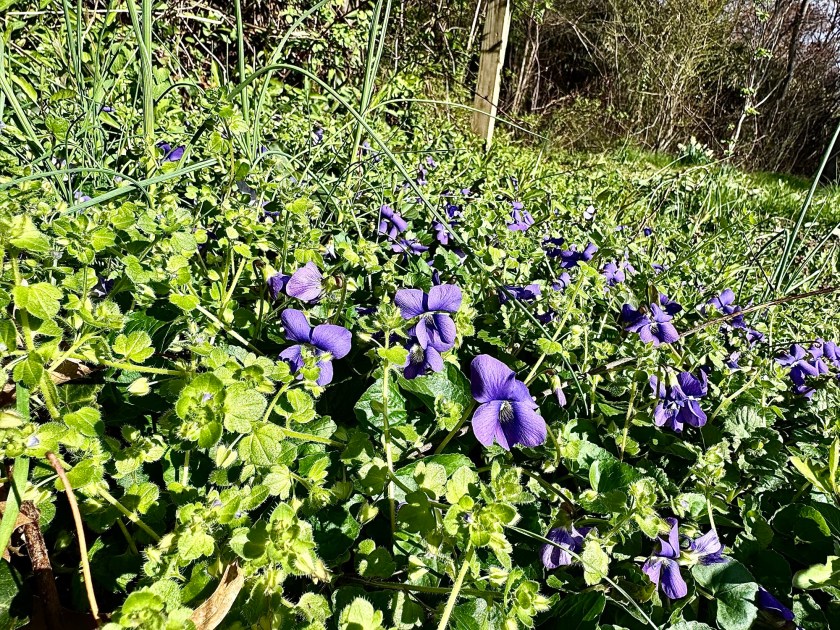
A springtime healer pops up with her friends
It’s the end of March in Virginia, and suddenly there they are, boldly flowering in patches, simultaneously with the bright daffodils, crocus, and yes…Daylight Savings Time.
Making a quiet entrance, after a harsh winter, including the late January ice and snow storm that inundated much of the Nation.
You may also enjoy reading Lady Prunella.
In any case, unafraid of the fact that occasionally it’s been known to snow in Virginia at Easter time, Blue Violet is bravely here, toting some close friends along, spindly spring onions and tiny Ms. Chickweed.
Wild violets (Viola Sororia) are a close relative of the pansy, both residing in the Violaceae family, and are even sometimes called a “wild pansy”.
They are both healers.
Healing herbs are often given a bad name in physicians and pharmaceutical circles now [as described later], but the perky little violet has no idea of this, and merrily grows with friends without a care. Unknowingly sometimes even getting plowed under or replaced for a “prettier lawn” or “better grazing”
Don’t do that. Let it grow in your pastures. Your horses will pick and choose what they want and need.
Native American Uses
The indigenous people of this continent were well aware of violets’ properties, soothing, antibacterial, and moisturizing. They were also utilized for their beautiful blue shaded pigments in art, dyes, and pottery.
Read more on the Native use of violets on the Adkins Arboretum Indigenous People’s Perspective Project page.
Other Violet facts:
FYI:
Violet extract in any form are unrelated to Methylene Blue or Gentian Violet, which are used in the excellent Wound Kote or Blue Kote horse products for wounds and thrush. Totally different compounds.
One more fact. Did you know that there is a whole underground world of these same herbs? They speak of “fairies”! But there’s real power in the roots of underground flowers, written about here in the Chestnut School of Herbal Medicine.
Violets’ Buddies
Frequently right among the Violets you’ll spy the wild onions, from which the domestic onions came, that we’ve always enjoyed in our cooking. Prairie folk frequently just picked these wild ones if they couldn’t get a regular onion.
Just about everyone knows how helpful onions are to peoples’ well-being, dropping cholesterol and so heart friendly, but you can read more here from none other than the Arthritis Foundation.
Good stuff!
Now her second buddy, the tiny Ms. Chickweed, makes a comfy bed for the violet to rest in.
Chickweed can be used internally or externally. As a poultice, it is soothing. Internally, it has a variety of applications
It’s possible to combine violets right in to the poultice.
Other chickweed uses include as a soothing tea or infusion for coughs, fevers, and urinary irritation.
- Personal advice for urinary discomforts: Use chickweed very judiciously with Slippery Elm, another effective historical remedy for lungs, digestion, and urinary irritation. An article for another day.
There are many articles on chickweed, here is the one that’s particularly interesting, from the Learning Herbs site.
Follow Your Physician’s Advice:
Remember to always talk to your doctor or veterinarian when you or your pet have a problem. Follow their advice first. Herbs alone are frequently not enough to resolve a problem.
Because of so many online quack medicinal claims, the movement towards merging conventional and holistic medicine has been slowed. There was beginning to exist noticeable advancement towards real cooperation between herbalists and doctors.
- For instance: healthcare workers offering patients a pad of lavender before going into the MRI tube, nice!
However, this cooperation seems to be more divided now, hopefully only temporarily. One day they will respect one another’s disciplines.
Summing it Up
Be sure and rinse your herbs in clear water and cider vinegar before throwing them on your salad raw.
But most of all, encourage the Violets to stick around, think twice about weeding them out of your garden or lawn and enjoy their beautiful presence.
Throw them in a salad, or simply appreciate the way the herbs all live and work together.
We can learn from their example.
Thank you for reading, hope you enjoyed it. Feel free to comment, like and share.

 Musicalhossgal